Xazna teardown: turning users of other banks' cards into bank customers
Xazna has more than 12 million users, and many of them come with cards from other banks. Using store reviews, my own screens and public data, I looked at where the path from "I use the app" to "I'm a Xalq Bank customer" breaks, and how I would fix it.
I use Xazna, the app of Xalq Bank in Uzbekistan, every day, with cards from two other banks. I had no Xalq Bank card, and that is the most interesting thing about the app: Xazna gathers other banks' customers. According to the bank, Xazna has more than 12 million users (bank post, Q1 2026). For the bank that is a ready base of future customers, if it can take a person from "I use the app" to "I have a Xalq Bank card".
Below is where I think that path breaks, and what I would do about it. It is based on 264 Google Play reviews and 64 App Store reviews since June 2025, my own screens of version 1.0.48, and public sources. I have no access to the bank's analytics, so everything below is a hypothesis that the bank's data can confirm or kill in a couple of weeks.
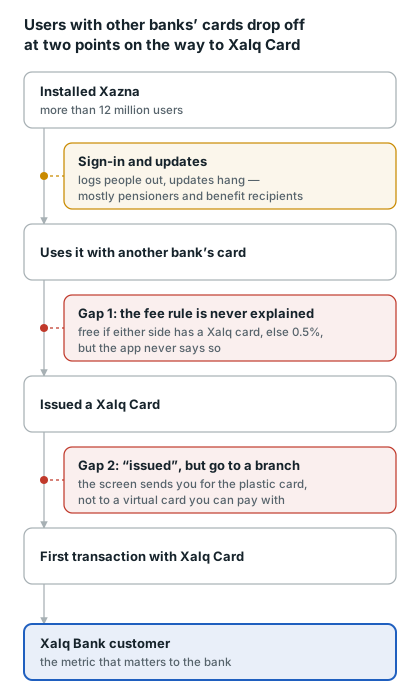
The metric that matters
For the bank, Xazna is a channel. The metric that matters is the share of app users who hold an active Xalq Bank product. The path to it: installed → uses the app with another bank's card → issued a Xalq Card → first transaction → bank customer. It breaks in two places, and both are screens the bank changes itself.
Gap 1: the app never says that a Xalq Bank card makes transfers free
In July 2025, transfers between cards of different banks in Xazna were free up to 5 million so'm a month (bank post). Reviews say that limit disappeared in November 2025, and Google Play saw a run of "I'm switching banks" reviews.
I checked how it works today myself, on 6 November 2026. From another bank's card to a Xalq Bank card the fee is zero, at both 5 and 6 million so'm. From a Xalq Bank card to another bank's card it is zero too. Only people whose cards are both from other banks pay: from one such card to another it is 0.5%. Between the bank's own cards, transfers are free up to 10 million so'm a month (bank post, 22 Oct 2026).
That is a simple rule: if either side has a Xalq Bank card, the transfer is free. The only people who pay are users with other banks' cards, exactly the people the bank wants to win as customers. But the app keeps quiet about it. The fee simply appears under the amount, and nothing says that a Xalq Bank card would remove it.
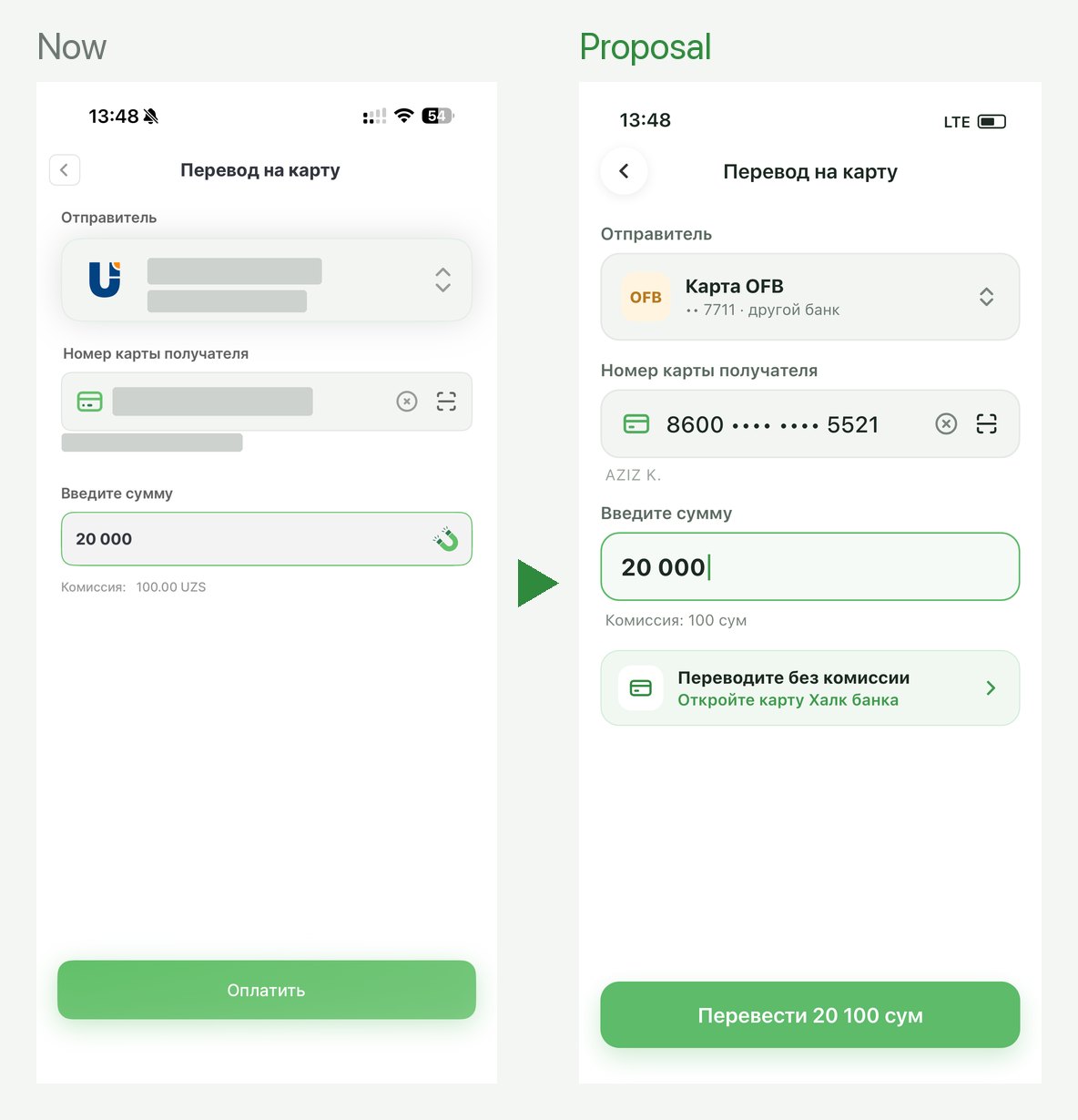
What I would do. On a paid transfer, show a banner under the fee: "Transfer with no fee: open a Xalq Bank card". It leads to card issuance, and if the virtual card works right away (see Gap 2), the person's next transfer is already free. The screen's focus stays on the "Transfer" button, so the banner does not get in the way of the current transfer. Measure banner taps, Xalq Cards issued from it, and the share of paid transfers.
Gap 2: the card is issued, and then what
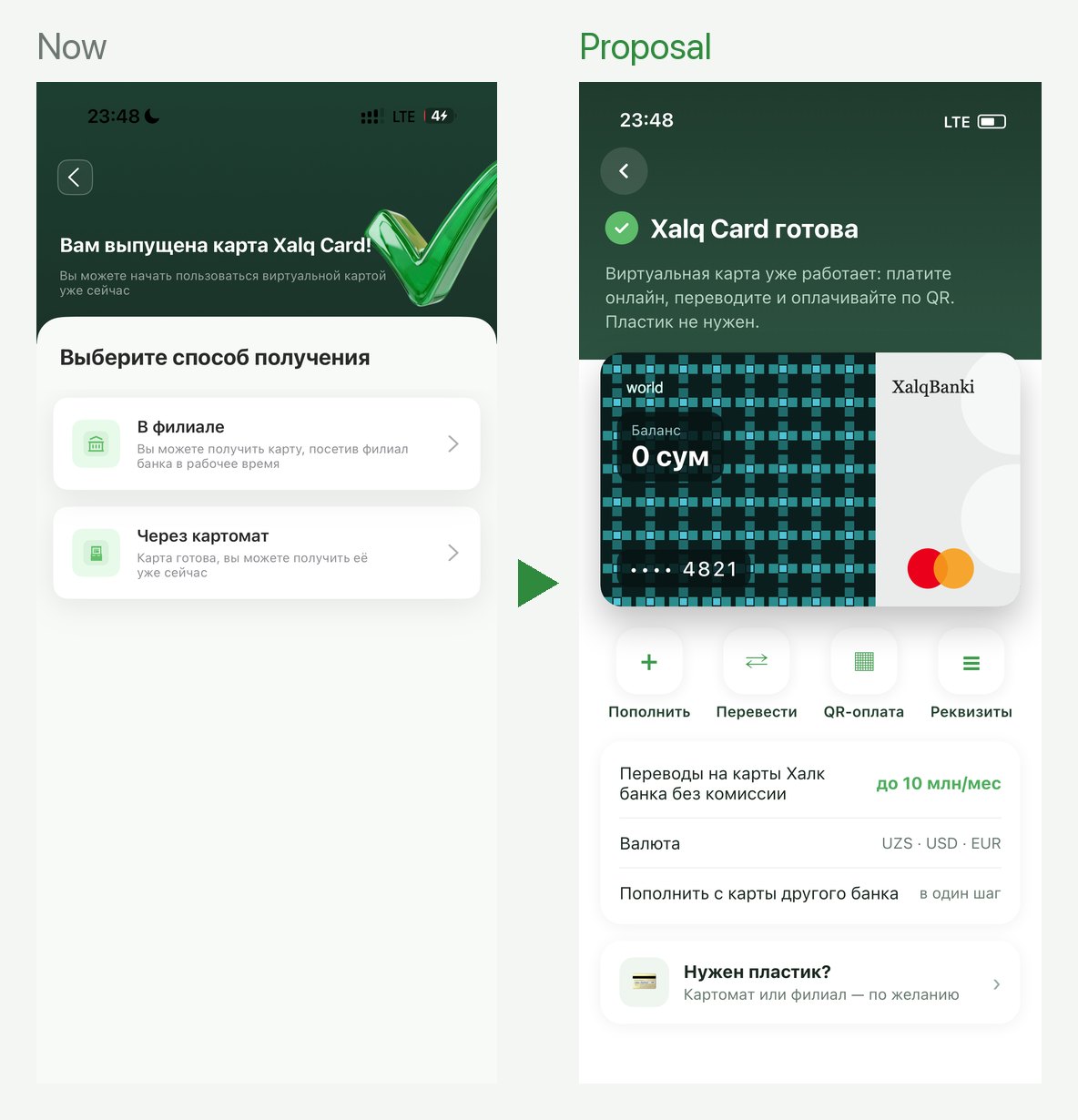
Ordering a Xalq Card ends with a promise: "You can start using your virtual card right now." But the screen offers only two routes, a branch or a card kiosk, and the activation screen asks you to collect the card at a branch. There are no card details and no "Top up" or "Pay" buttons, so it is not clear whether you can pay right now.
Other Uzbek banks are ahead here:
- Uzum Bank: the virtual card works right after the identity check (App Store);
- Anorbank, HUMO TRIA Virtual: "ready right after ordering" (anorbank.uz);
- TBC, Humo/Uzcard Virtual: about 15 minutes, no branch visit (tbcbank.uz);
- Hamkorbank, Visa Virtual in dollars and euros: right away, for online purchases (hamkorbank.uz).
Xalq Bank itself issued a virtual card in Xazna "in a few minutes", with no branch visit, back in 2023 (bank post). The bank already knows how to do "issue it and pay at once".
What I would do. Right after issuing, show the virtual card with its details and "Top up", "Transfer" and "Pay by QR" buttons. The plastic card comes second, and only if the customer wants it. Measure the share of issued cards with a first transaction within 7 days.
Who else gets lost
Xazna's second large audience is pensioners and people who receive state benefits. There is a version for them, xazna Lite (bank post), but the "Pro or Lite" choice on first launch does not say that Lite is made for them. In reviews this audience has its own pains: the app logs them out and asks them to register again, it will not open without an update, and the paid transaction monitoring cannot be switched off.
There is also an entry point worth using: state payouts. 28,800 parents received the "Suyunchi puli" birth benefit in September 2025 (zamin.uz). 74,000 people have been refunded for international exams, and the refund can only be claimed in Xazna (uza.uz). Someone who came for a payout is a ready candidate for a Xalq Card issued on the spot.
What it could be worth
How many Xazna users rely only on other banks' cards is not public. If it is 20% of 12 million, and 5% of them issue a Xalq Card and start using it within six months, that is about 120,000 new active cards. That is a sixth of the bank's quarterly card issuance (738,000 in Q1 2026, bank post), with no acquisition cost. In a cautious scenario, 10% and 3%, it is about 36,000.
What I would do in six weeks
- Week 1: instrument the funnel "transfer from another bank's card → Xalq Card issued → first transaction", and ship the quick fixes.
- Weeks 1–3: the virtual Xalq Card works right after it is issued.
- Weeks 2–4: a "Transfer with no fee" banner leading to a Xalq Card on the paid-transfer screen, as an A/B test on part of the users.
- Weeks 3–6: sign-in without re-registration, soft updates, and a "Claim a payout" path.
What I took from it
- The cheapest audience is the one already opening your app. It needs a path, not acquisition.
- A change customers dislike, like a new fee, is also the best moment to show them the way out.
- What a screen promises should match what the person can do right now.